Hello! This is an example Patreon blog! Members at the $20/month tier receive these for free every week, but they are also available for a one-time donation in the Patreon Shop.
While most people think of the great Highland bagpipes when they hear the word “bagpipes,” there are over a hundred different types of bagpipes from around the world. I mentioned one variety in both Folk Files episodes on folk instruments: the cabrette. It is a French instrument that uses a bellows mechanism (so, similar to a Uillean pipe, you don’t need to blow into it) and has an easily exchangeable drone/chanter system, which means that musicians can play in different keys.
The cabrette doesn’t have a bass drone like the great Highland bagpipes, but it makes up for that in its ability to play chromatic notes through cross-fingering. Cross-fingering is a method that allows musicians to access notes outside the diatonic scale through elaborate finger patterns. France’s culture has been associated with bagpipes for a long time, as is evidenced by the illustrations in The Hours of Jeanne d’Evreux, Queen of France, an early 14th century manuscript, which you can see here.
Other European Bagpipes
The German dudelsack is much more similar to the great Highland bagpipes than the cabrette. The instrument, which is usually only played in a historical context (i.e. by medieval bands or at renaissance festivals) usually features two drones. The ends of the pipes tend to be more flared than standard, modern bagpipes. The term “dudelsack” probably comes from the Czech or Polish term “dudy” which means “bagpipes.” Despite this etymology, the German dudelsack is very different from the Bohemian dudy.
The Bohemian dudy’s chanter and drone are curved at the ends, similar to drinking horns or funnels. I’ve seen versions that you blow into as well as ones that are operated by a bellows mechanism. The bag can also be of varying sizes, as you can see with this example, where the bag is the size of a sheep. It could actually be a sheep…because early bagpipe bags were made from the skin of an entire animal. Now they’re mainly made from artificial materials like Goretex.
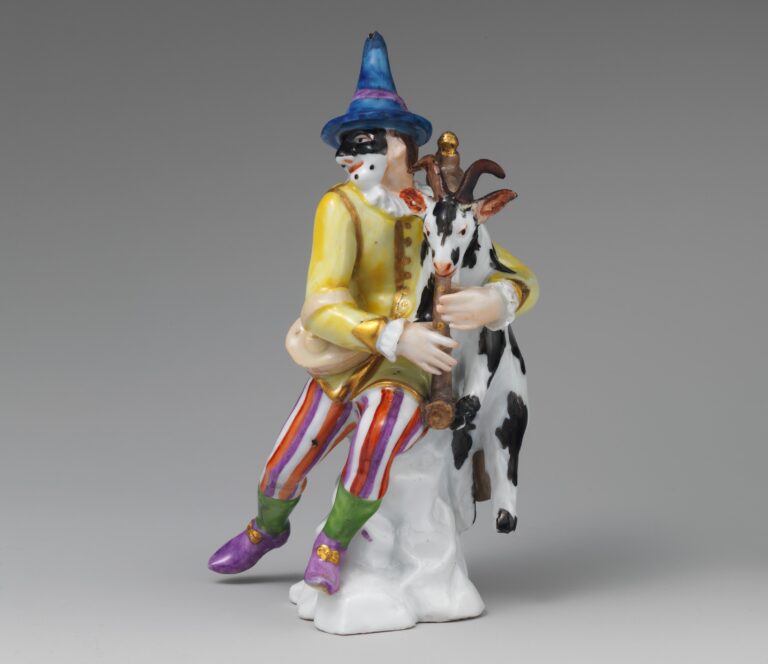
Another Bohemian bagpipe, the bock, is often depicted as having all the parts of the animal still attached, so that the musician essentially plays a piece of taxidermy with pipes stuck in it. Despite these artistic depictions, like the 18th century statuette seen above, most bock bags do not have horns or legs attached, though they might feature goat hide still attached to the goatskin.
A Pastoral Instrument
Across cultures, bagpipes are associated with rural communities, perhaps due to this connection between animal hides and the instrument’s production (or perhaps cities were too densely populated for neighbors to appreciate bagpipe playing!). In Italy, there is a bagpipe called the zampogna, which you can see a shepherd playing on this nineteenth century brooch:
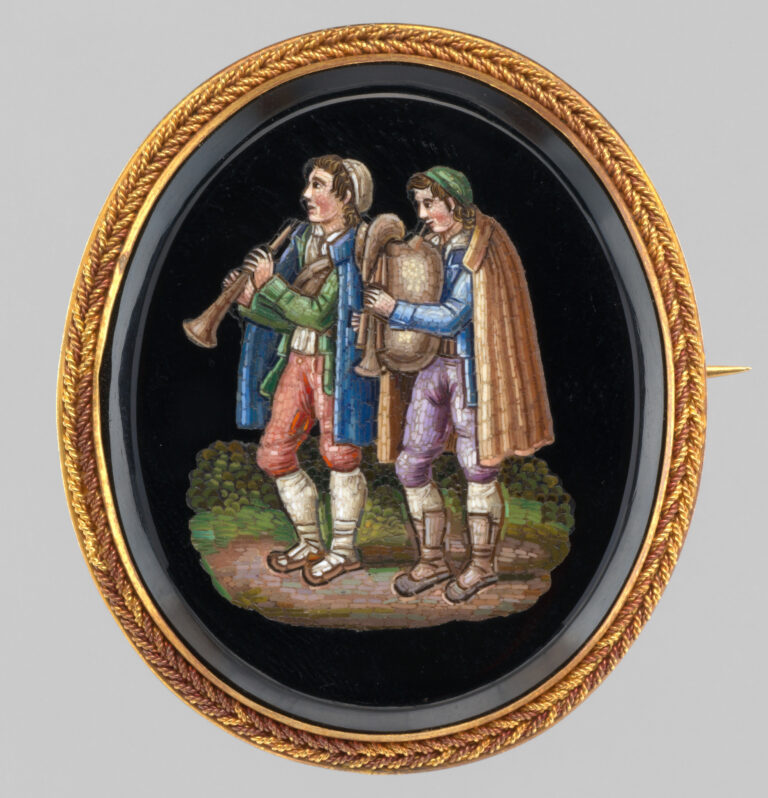
The zampogna is polyphonic, thanks to two melodic pipes, which you can hear here.
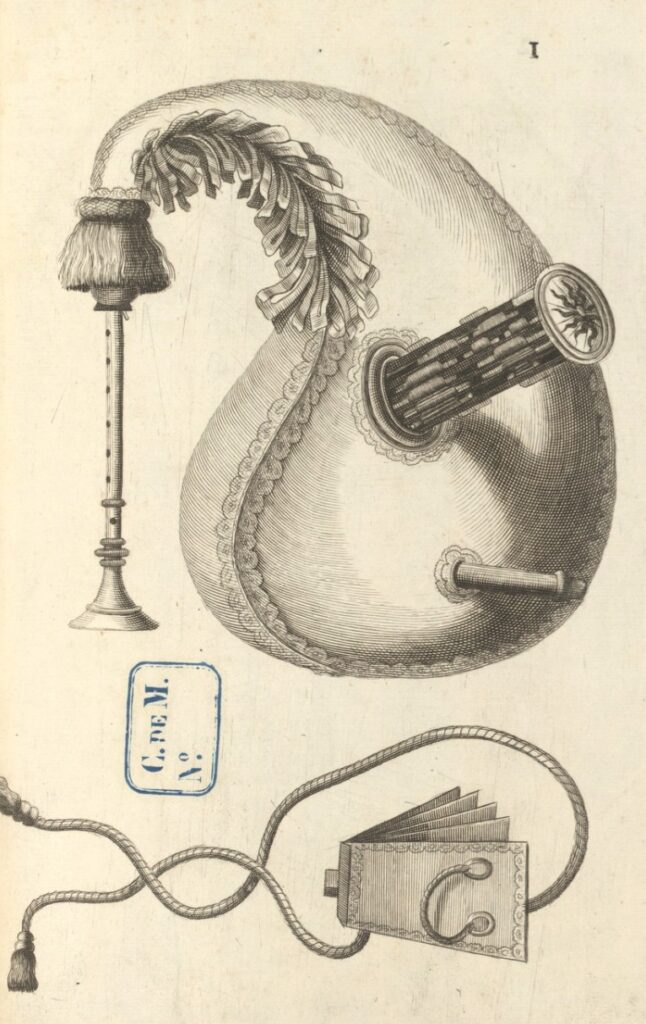
Another instrument with two melodic pipes is the baroque musette, but it is different from other bagpipes in that it’s relatively quiet. It was designed for indoor performances, such as this one, accompanied by the virginal. Often made of expensive materials, musettes were usually covered in genteel fabrics like silk or brocade. The instrument was popular around the same time that French aristocrats dressed up in (very clean) shepherd and shepherdess costumes and built carefully manicured rustic oases to wander around in. The aristocracy wanted the rustic charm of the bagpipes, but without all the noise.
Bagpipes of Asia and Africa
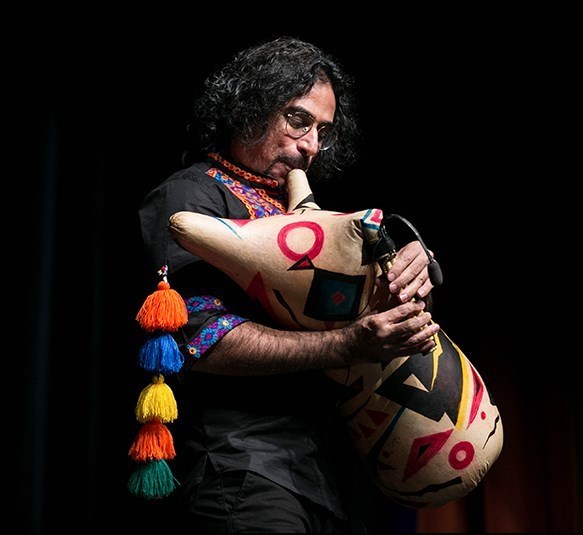
In Iran, the ney-anbān (which literally means “bag pipe”) is a bagpipe with two chanters and no drone, historically made from the body of a goat. It’s particularly popular in the Bushehr region, where it is often accompanies sarva, a musical genre characterized by singers singing free meter couplets. Here is Mohsen Sharifian playing the ney-anbān.
In Northern Africa, specifically Libya, musicians play the zukra, which is a bagpipe that features two chanters with cow horns at the end. Historically, the pipe that the player blows into would be made out of bone (usually from a vulture or other large bird). The Tunisian version of the zukra, called the mizwid, was associated with popular music as late as the 20th century. However, by the end of the 20th century, synthesizers replaced the mizwid, because their electronic sound mimicked the buzzing melodies of the bagpipes.
There is also a bagpipe tradition in India, where the main northern variety is known as the mashak. The name refers to a skin bag that was traditionally used for carrying water. There is some debate over the origin of the mashak. Some people believe that it is simply a descendant of the Highland bagpipes, which was brought to India by British colonizers. But other musical historians claim that there was an indigenous mashak before the arrival of the Scottish pipes, and they were simply superseded by the Highland bagpipes. Either way, the mashak is an important cultural part of Northern India, especially in Uttarakhand where the pipes frequently accompany rural wedding ceremonies.
…and More Bagpipes from Around the World!
To discuss every type of bagpipe around the world would require a whole book, but hopefully this post gives a short, satisfactory introduction to bagpipes from Western Europe, Eastern Europe, Northern Africa, the Middle East, and Southeast Asia. There’s so much more than just the Piob Mhór! (That rhymes!)